
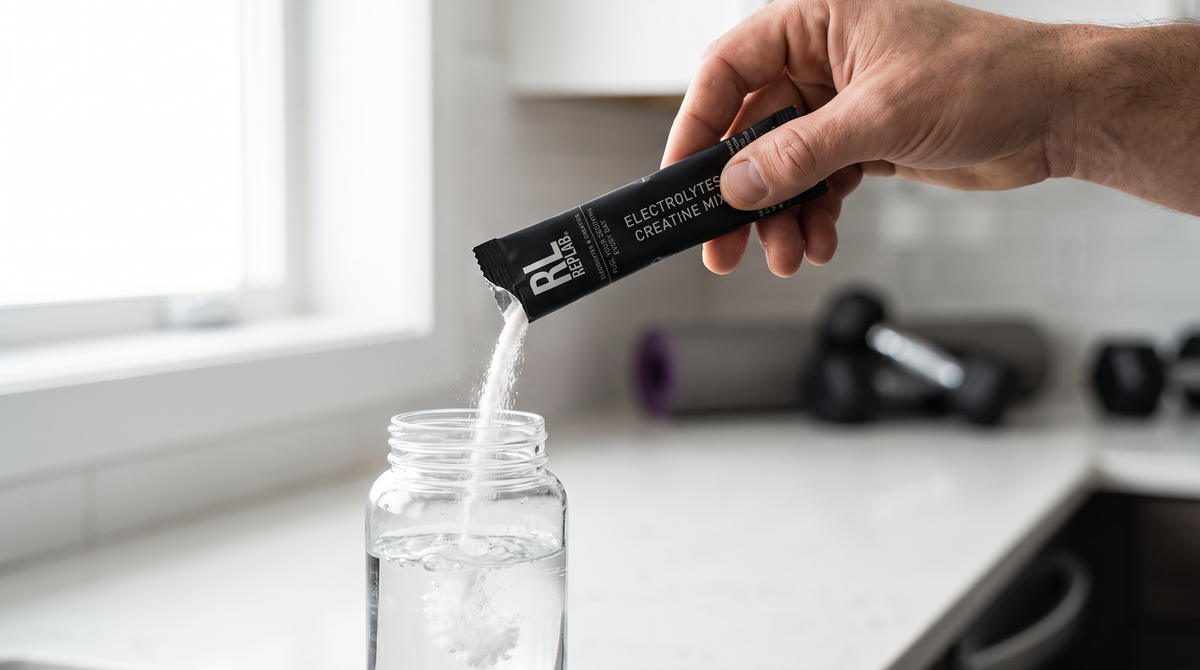
Creatine and electrolytes can be included in the same drink. Combined formulations have been studied, but that does not mean every blend works better than creatine alone. The practical reason to choose a combined product is often convenience: one serving instead of preparing separate products. [1]
The useful question is whether the label and serving directions suit your routine.
Does adding electrolytes make creatine more effective?
Do not assume it does. In a trial of a creatine-electrolyte formulation, the comparison was with a placebo—not with creatine alone. The authors identified comparison against creatine monohydrate as a next step. The formulation also differed from REPLAB’s. [1]
That distinction matters when reading supplement advertising. A study of one ingredient combination is not proof that a different product will deliver the same result, or outperform a simpler option.
Choose based on clearly stated amounts and practical fit, rather than an implied absorption advantage.
Check the quantities per serving
Start with the serving size, then read the ingredient amounts underneath it. A large number on the front of a bag might describe the total blend rather than the amount of creatine.
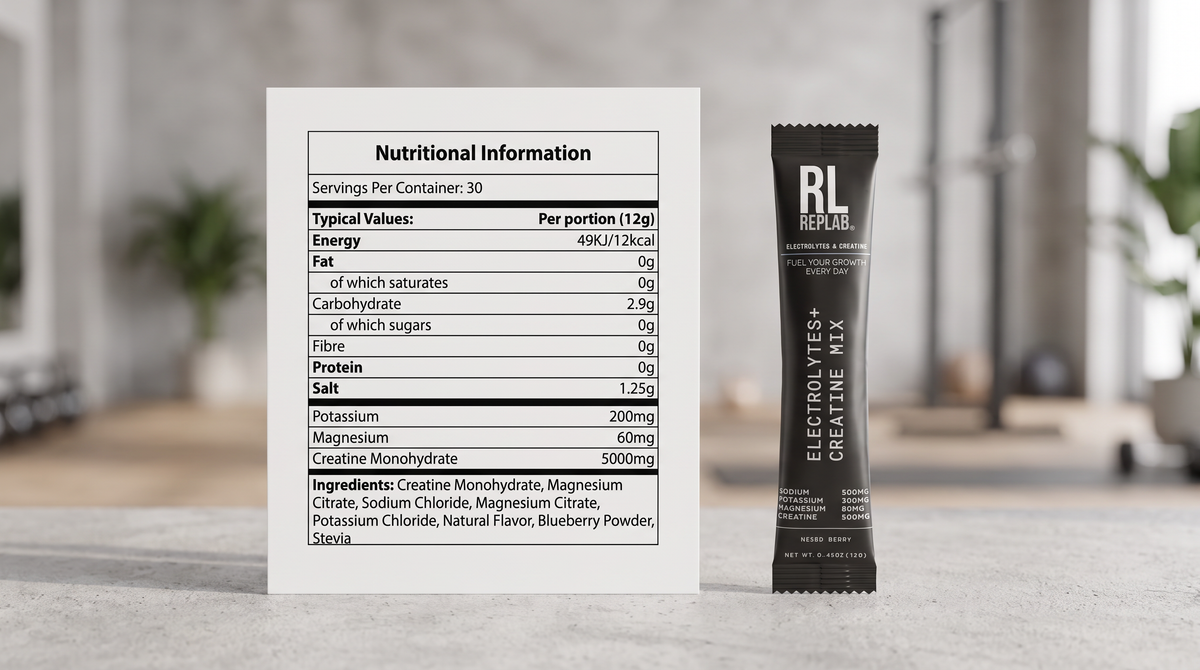
REPLAB’s stated per-sachet formulation is:
Ingredient Amount
Creatine monohydrate 5g
Sodium 500mg
Potassium 200mg
Magnesium 60mg
The amounts let you compare the product with what you already take. They do not mean every person needs additional electrolytes every day.
For background on the minerals, read our electrolytes and hydration guide.
Avoid accidentally doubling up
Imagine that your routine already includes plain creatine. You then add a combined creatine-electrolyte sachet because you want something flavoured in your bottle. Unless you check both labels, you might take more creatine than intended.
The same problem can occur when you use several drinks with overlapping ingredients.
Before changing the routine:
1. List each supplement you plan to use.
2. Write the amount of each shared ingredient per serving.
3. Add the quantities across the day.
4. Follow the relevant directions rather than assuming each product should be added on top.
For everyday creatine amounts, see our creatine dosage guide.
How should you prepare the drink?
Follow the product’s mixing instructions and use a clean bottle. If using two separate products, check both sets of directions and whether the manufacturers permit mixing them.
Prepare only what you need rather than treating your bottle as a container for every supplement you own. A straightforward routine is easier to repeat and easier to review if something does not agree with you.
Do not use extra combined servings simply to obtain more electrolytes: the creatine amount increases at the same time. Any additional fluid or electrolyte needs should be considered separately.
Who might prefer a combined sachet?
It may suit someone who already wants the listed ingredients, values a pre-portioned serving and carries their supplement to work or training. Someone who only wants creatine may prefer a plain product.
If you have kidney disease, prescribed fluid or mineral restrictions, or medicines that affect electrolyte balance, check suitability with your clinician or pharmacist first.
Is a combined drink compulsory?
No. It is a format choice. Separate products can also make sense.
Can a study on another blend prove REPLAB’s results?
No. Different formulations and study comparisons cannot be treated as interchangeable.
View REPLAB’s creatine and electrolyte sachets to compare the ingredients and directions with your current routine.

Leave a comment
This site is protected by hCaptcha and the hCaptcha Privacy Policy and Terms of Service apply.